

Unprecedented growth of aerosols in the stratosphere from the Raikoke eruption (2019).
Published: 17, September, 2026
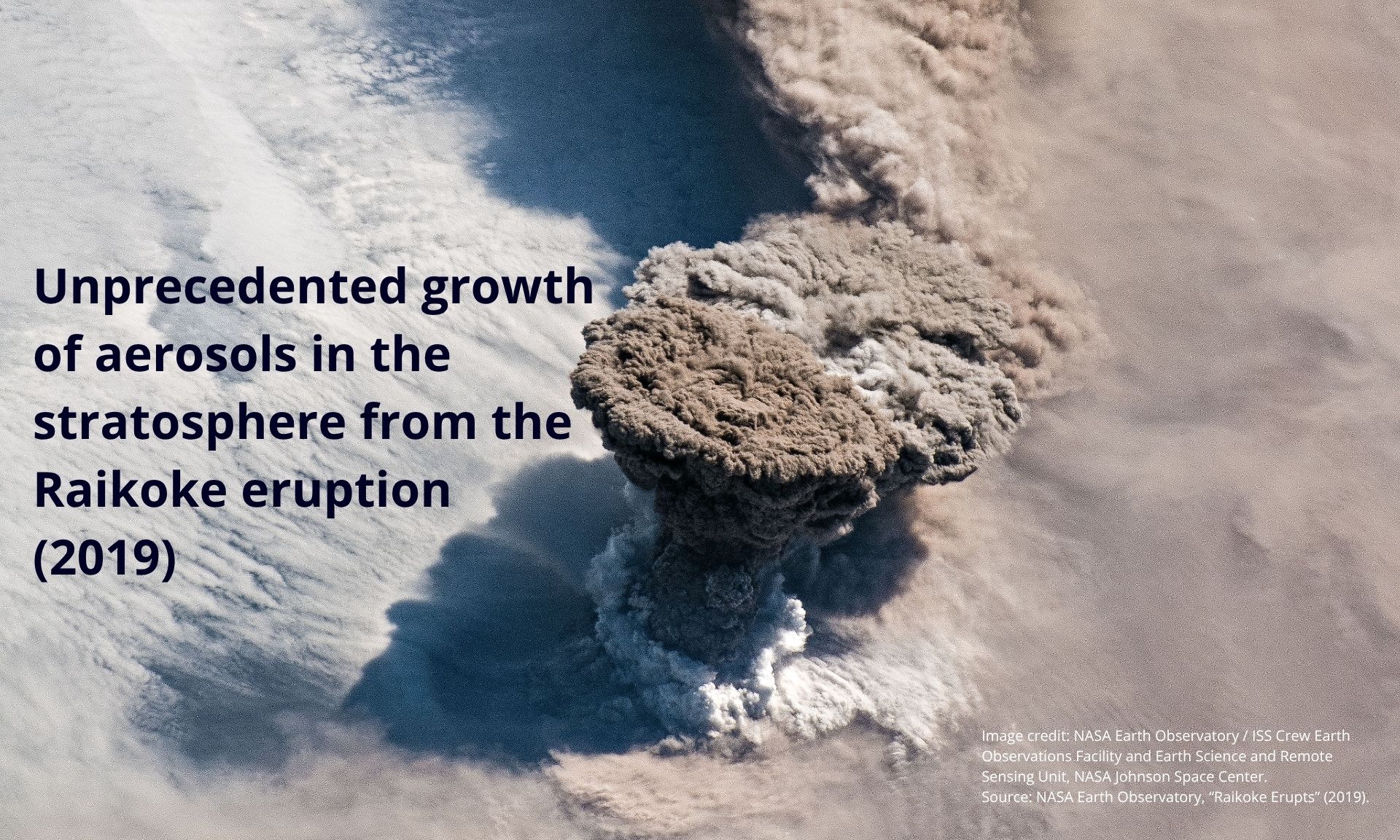
Unprecedented growth of aerosols in the stratosphere from the Raikoke eruption (2019), what are the climatic impacts?
The exact nature of the particles injected into the stratosphere after a volcanic eruption is of primary importance to understand their impact on climate. Volcanic emissions are rich in sulfur dioxide (SO2), a gas which converts into sulfuric acid droplets in the stratosphere. Generally, climate modelers only consider the role of sulfuric aerosols, or sulfates, for their capacity to modify the Earth’s radiative balance. By reflecting sunlight, these sulfates will tend to cool the Earth’s surface. In the case of explosive eruptions, the influence of ash particles is commonly neglected, as it is considered that they deposit rapidly, in a few hours or a few days.
However, a new study from researchers of the Laboratoire d’Optique Atmosphérique, Université de Lille (LOA) and from the Institut de Physique du Globe de Paris (IPGP), carried with engineers from the AERIS/ICARE national center for atmospheric data and services of the DATA TERRA infrastructure, shows that volcanic ash particles of submicronic size could persist for weeks in the stratosphere. The analysis demonstrates that ultra-fine ash become coated by sulfates, hiding their true nature. An ash core could play a fundamental role by driving fundamental atmospheric processes, like a record sulfate aerosol growth. Hence, revisiting the exact nature of stratospheric aerosols and their size is crucial to better understand and model the impact of volcanism on climate.
In June 2019, the major volcanic eruption of the Raikoke volcano, located in the Kuril Islands, led to a significant perturbation of the stratospheric aerosol layer for more than six months. Using the VOLCPLUME web platform of the Volcano Space Observatory (VSO), allowing a synergistic analysis of satellite observations and photometric ground measurements from the global AERONET network, together with a new methodology developed for the exceptional Hunga eruption [Boichu et al., 2023], the size and composition of the Raikoke particles were analyzed.
The Raikoke volcano emitted between 1.5 and 2.1 Tg (or million tonnes) of SO2 into the stratosphere, between 10 and 15 km of altitude. While most of the volcanic plume dispersed into the Northern Hemisphere (Fig. 1a), a subset turned into a vortex, developing independently (Fig. 1b). The observation of a vorticized plume is new for a volcanic eruption, but already documented for megafire plumes. This phenomenon, with a lifetime of two to three months, questions the nature of the particles inside of it.
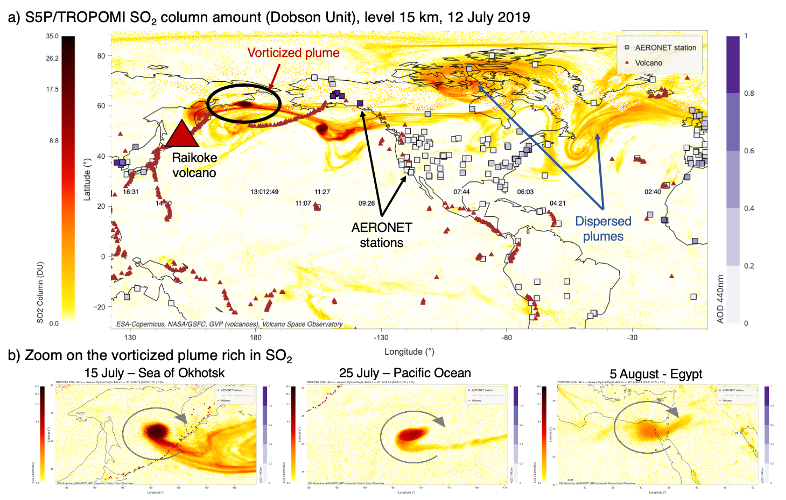
Figure 1: a) Dispersion in the Northern Hemisphere of the SO2-rich plumes from Raikoke volcano (red triangle), observed on 12 July 2019 by the satellite S5P/TROPOMI (SO2 CA (DU) – 15 km product) and visualized on the web platform VSO/VolcPlume. We distinguish the vorticized plume (circled in black) from the dispersed plume, overpassing AERONET stations (squares colored by the aerosol optical depth AOD at 440 nm). b) Zooms on the vorticized plume on 15 July, 25 July and 5 August showing SO2 abundance and anticyclonic nature.
In the vorticized plume, the aerosols grew rapidly to a size of 0.3 µm in radius, two weeks after the eruption, and up to 0.9 µm after three months (Fig. 2, red hexagons). Such size was never documented in previous volcanic plumes. For comparison, in the dispersed plumes, the radius stabilizes after three weeks, reaching only 0.3 µm. More broadly, the radius of the aerosols in the Raikoke vorticized plume is larger than the one of the 1991 Mount Pinatubo eruption aerosols (Philippines), a major eruption with a climate impact that marked the 20th century and emitted 10 to 15 times more SO2.
This study shows that the growth of aerosols is constrained by the SO2 concentration in plume parcels and not by the total emission sulfur budget of an eruption, parameter generally chosen for initialization of climate models. Indeed, the vorticized plume is extremely rich in SO2, which has greatly enhanced the formation and growth of sulfuric aerosols.
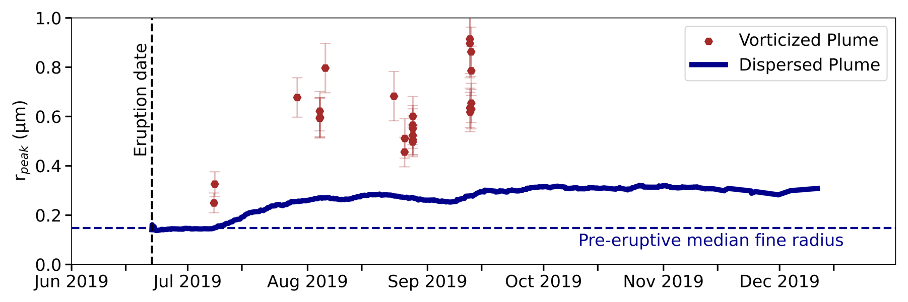
Figure 2: Growth of Raikoke aerosols in the vorticized plume (red) and the dispersed plumes (blue) since the eruption (vertical dashed line). The vorticized plume was detected above nine AERONET stations, giving 25 peak radius sizes in three months. The dispersed plumes were detected continuously for six months above a great number of AERONET stations, we plot the 15-day window moving average. Horizontal dashed line shows the median radius of fine background aerosols on two pre-eruptive years.
Furthermore, the analysis of the depolarization properties of the aerosols with the LiDAR CALIOP (aboard CALIPSO satellite, decommissioned today), combined to their radiative properties from AERONET, revealed that the plumes were not composed of pure sulfates, but also ultra-fine ash (radius < 0.2-0.3 µm) coated with sulfates. This ash core, with absorbing properties, heats up and maintains the vorticized plume, explaining its elevation of more than 10 km in two months. An analogy can be made with vorticized plumes from megafires, which are maintained by absorbing aerosols made of black carbon.
In the end, although they are often neglected in climate models, the study shows that ultra-fine volcanic ash particles could persist for a few months in the stratosphere, affecting the plume dynamics and aerosol life cycle. Aerosols from the Raikoke eruption have shown new characteristics requestioning the admitted approach for the modeling of climate impact of volcanism. It invites us to revisit past eruptions with fresh eyes.
Read the full article here.
Contacts
Paul Ruyneau de Saint-George (Univ. Lille, Laboratoire d’Optique Atmosphérique LOA), paul.ruyneau-de-saint-george@univ-lille.fr
Marie Boichu (CNRS, Univ. Lille, Laboratoire d’Optique Atmosphérique LOA), marie.boichu@univ-lille.fr
Reference:
Ruyneau de Saint-George, P., Boichu, M., Bonnat, J. et al. Record growth of stratospheric aerosols from 2019 Raikoke eruption with sulfate-coating of submicronic ash. Sci Rep 16, 27697 (2026). https://doi.org/10.1038/s41598-026-52949-y