
Image

Published: 30, September, 2025
Keywords: Air Quality, Atmosphere, Protocols, Co-design
The Horizon 2020 project RI-URBANS worked to develop new tools for gaining a deeper understanding of air quality. The project consortium was comprised of RPOs across Europe (and covering a major portion of the ACTRIS network), as well as 19 associated collaborators, several of which came from private sector (instrument manufacturers such as INOESY and Airmodus).
European air-quality monitoring networks have primarily focused on regulated pollutants and mass-based indicators such as PM₂.₅ and PM₁₀. However, there was a lack of measurements and knowledge for observing emerging risks such as ultrafine particles, black carbon, oxidative potential, ammonia, volatile organic compounds and non-exhaust traffic emissions. The Air Quality Directive and World Health Organisation have called for greater understandings of their impacts on the environment and human health.
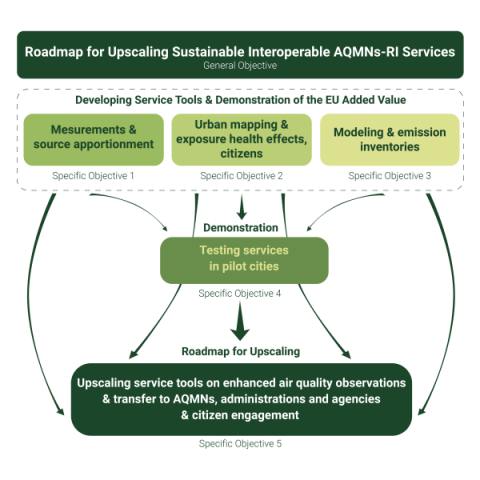
RI-URBANS sought to bridge the gap between the operations of European air-quality monitoring networks and the high-quality atmospheric observations and technical knowledge of European RPOs and RIs. To help achieve this goal, the project produced 16 Service Tools, methods or tools that the project reviewed, tested and recommended for use in urban areas, supported by measurement protocols, modelling methods and practical implementation guidance. This in turn translated advanced research capabilities into interoperable, sustainable services that operational monitoring networks can use, including in cities and at industrial, harbour, airport and traffic hotspots.
The project partners reviewed existing knowledge and services according to their expertise, converting these into operational tools with recommendations covering instrumentation, calibration, operating conditions, data management, quality assurance, source-apportionment procedures and modelling. Where established standards were available, the tools drew on protocols associated with ACTRIS and CEN; where protocols were missing, the project proposed new procedures.
The tools were tested through 5 pilot configurations across 9 European urban areas: Athens, Barcelona, Birmingham, Bucharest, Helsinki, Milan–Bologna, Paris, Rotterdam–Amsterdam and Zurich. This pilot structure enabled the partners to compare methods, integrate different components of an urban observing system and assess whether the services could operate within real monitoring-network conditions rather than only in research settings.
The project also gathered input, needs, wishes and expertise of major stakeholders in the air quality sector, including experts from the European Environment Agency, World Health Organization, World Meteorological Organization and European Monitoring and Evaluation Programme.
The tools became the portfolio of 16 Service Tools which are publicly available on the RI-URBANS website. The portfolio includes measurement protocols, source-apportionment methods, mobile and citizen-science approaches, health-evaluation methods, emissions inventories and urban-to-regional modelling tools. Clear user procedures and downloadable guidance make the results available to monitoring agencies and other practitioners.
The portfolio is also relevant to the revised EU Ambient Air Quality Directive 2024/2881, which places increased attention on emerging pollutants including ultrafine particles, black carbon, elemental carbon, ammonia and particle oxidative potential, pollutants which the Service Tools provide measurement guidance on.